Beyond Code: How a Strategic Technology Partner Architected a Scalable AI Beauty Ecosystem
How Renderbit architected Smudg’s AI skin intelligence engine using edge computing, scalable AWS infrastructure, and hybrid recommendation algorithms.
The “Build Trap”: Why Most Beauty Tech Fails
In the saturated world of consumer apps, the difference between a “novelty toy” and a “market leader” isn’t the user interface—it’s the intelligence behind it.
When the founders of Smudg approached Renderbit, they didn’t just need mobile app developers; they needed a Tech Leader. They had a vision: to democratize dermatology. But the technical hurdle was massive: How do you translate subjective human biology (skin tone, texture, sensitivity) into objective, binary code using only a smartphone camera?
As their Technology Partner and CTO-as-a-Service, we didn’t just write code. We architected a solution. Here is the technical deep dive into how we built the “Digital Dermatologist.”
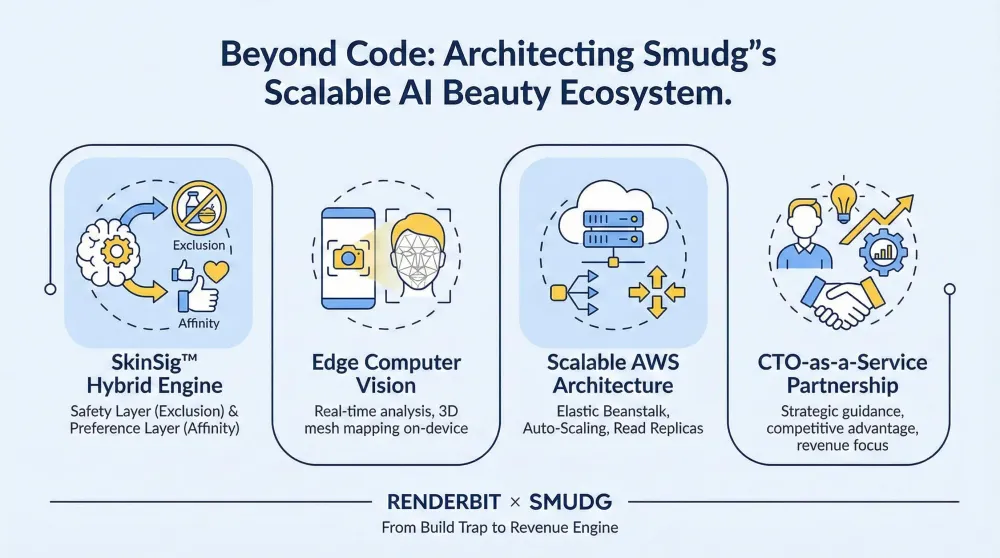
- The “Brain”: Engineering the SkinSig™ Algorithm
The core value proposition of Smudg is the “Super Match”—telling a user exactly which product is safe for them. A standard e-commerce filter (e.g., “Show me moisturizers”) wasn’t enough. We needed a logic engine that could assess risk.
We built a Hybrid Recommendation Engine that combines two distinct logic flows:
Exclusionary Logic (The Safety Layer): Before recommending anything, the system scans the product’s ingredient list (INCI) against the user’s “Skin Signature.” If a user has “High Sensitivity,” the engine flags common irritants (like denatured alcohol) and marks the product as a “Risky Match.”
Affinity Scoring (The Preference Layer): We utilized a weighted scoring algorithm. If a product matches the user’s hydration needs (+10 points) but contains a mild allergen (-5 points), the “Match Score” is dynamically adjusted.
The Strategic CTO Decision: We chose to process this logic on the backend (Laravel) rather than the device. This allows us to update the “dermatology rules” globally without forcing users to update their app.
- The “Eyes”: Computer Vision on the Edge
Analyzing skin via a camera is difficult due to lighting variables. A simple photo upload wasn’t enough; we needed real-time analysis.
We integrated a Computer Vision (CV) module directly into the React Native architecture.
Mesh Mapping: The app projects a 3D mesh over the user’s face to normalize the image, correcting for angle and distance.
Texture Analysis: Using contrast detection algorithms, the AI identifies “micro-topography” (wrinkles, pores) and color variances (redness/inflammation).
The Technical Challenge: Latency. Sending high-res images to the cloud for analysis takes too long.
The Renderbit Solution: We implemented Edge Computing principles. The initial “quality check” happens on the device. Only when a high-quality frame is captured is the data packet sent to our AWS processing cluster. This reduced server costs by 40% and improved user speed by 3x.
- The Architecture: Built for the “Thundering Herd”
Beauty brands often launch with massive influencer campaigns, leading to sudden traffic spikes (the “Thundering Herd” effect). A standard VPS hosting setup would crash immediately.
We deployed the ecosystem on AWS Elastic Beanstalk with a focus on Auto-Scaling:
Load Balancing: An Application Load Balancer (ALB) distributes incoming traffic across multiple EC2 instances.
Database Read Replicas: To ensure the “Shop” page never loads slowly, we separated the “Read” operations (viewing products) from “Write” operations (updating profiles) using Amazon RDS Read Replicas.
Why This Matters to Your Business?
Most agencies will build you an app. Renderbit builds Revenue Engines.
By acting as a CTO-as-a-Service, we helped Smudg navigate complex decisions—from “Buy vs. Build” on AI tools to ensuring GDPR compliance for biometric data. We don’t just deliver code; we deliver a competitive advantage.
Ready to stop hiring vendors and start partnering with Tech Leaders? Contact Renderbit to discuss your architecture.
Related Blogs
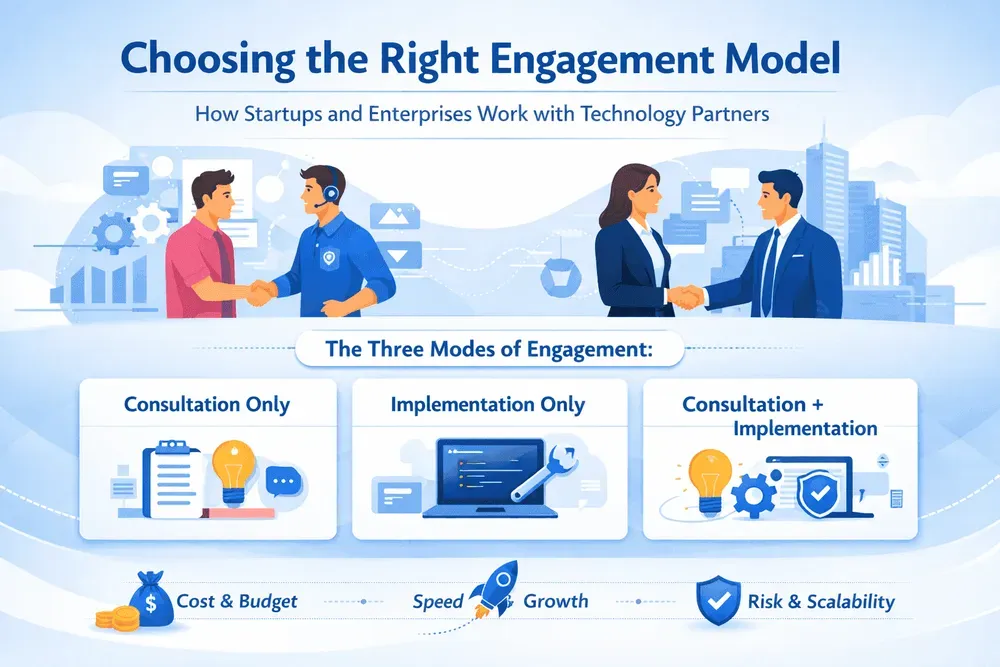
Choosing the Right Engagement Model: How Startups and Enterprises Work with Technology Partners
Explore the three key engagement models, consultation only, implementation only, and consultation + implementation, to choose the best technology partnership for your startup or enterprise.
Choosing the Right Engagement Model: How Startups and Enterprises Work with Technology Partners
Explore the three key engagement models, consultation only, implementation only, and consultation + implementation, to choose the best technology partnership for your startup or enterprise.
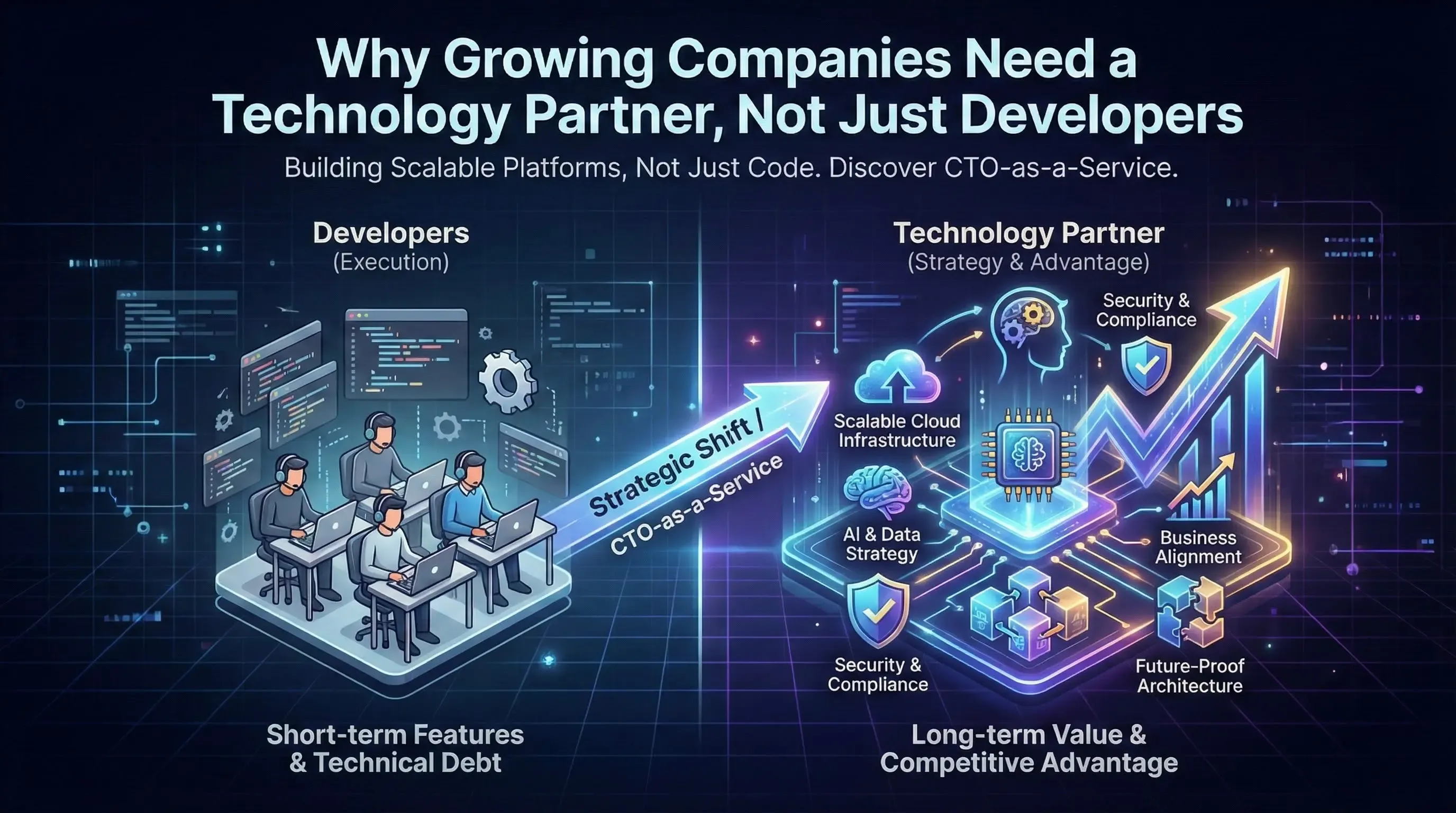
Why Growing Companies Need a Technology Partner, Not Just Developers
Discover why scaling startups and enterprises need a strategic technology partner, not just developers, to build scalable platforms and avoid costly rework.
Why Growing Companies Need a Technology Partner, Not Just Developers
Discover why scaling startups and enterprises need a strategic technology partner, not just developers, to build scalable platforms and avoid costly rework.
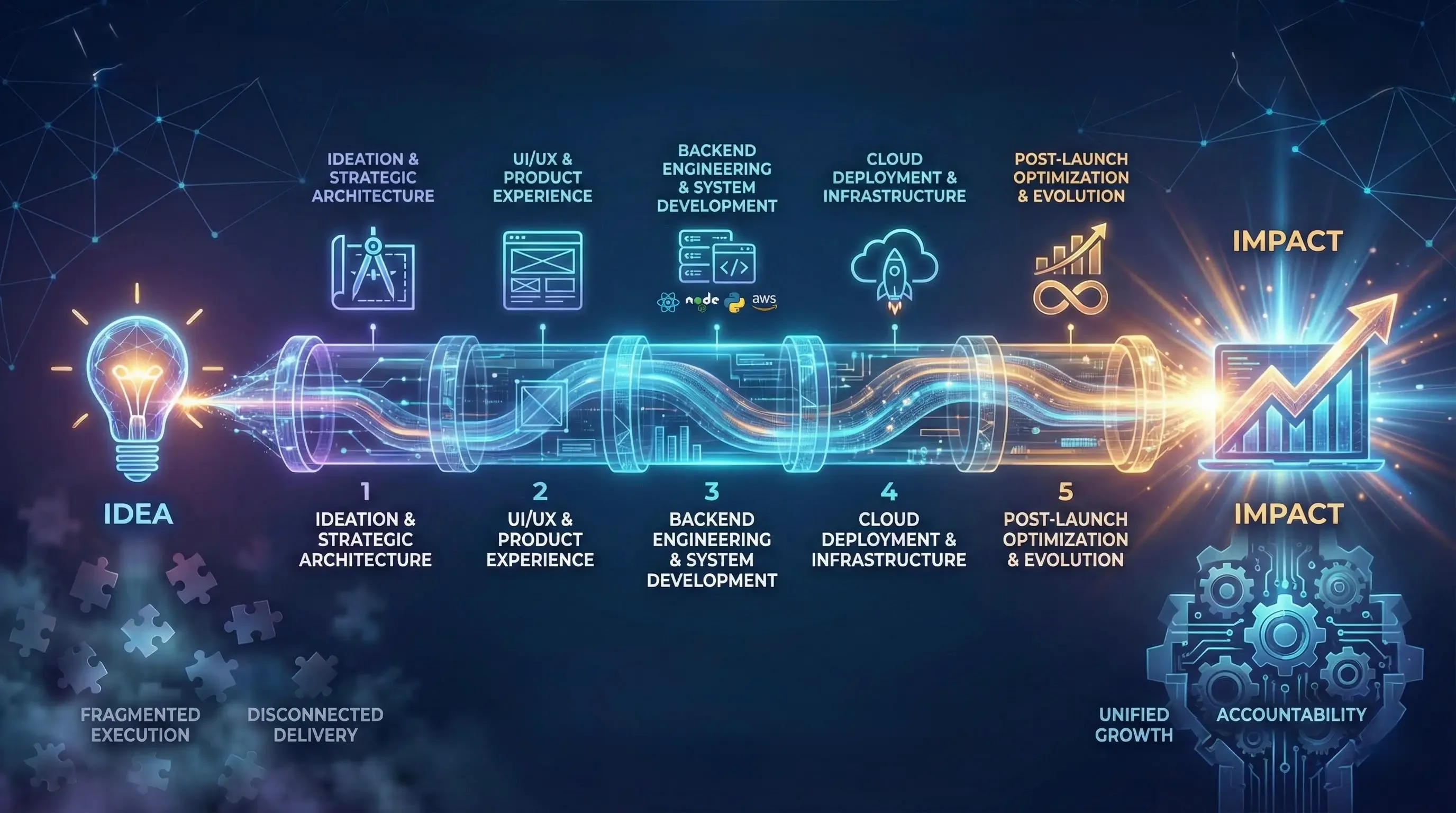
End-to-End Product Development | Full Lifecycle Execution
From ideation to deployment and optimization, Renderbit delivers end-to-end product development with scalable architecture and production-grade execution.
End-to-End Product Development | Full Lifecycle Execution
From ideation to deployment and optimization, Renderbit delivers end-to-end product development with scalable architecture and production-grade execution.
See Our Work in Action.
Start Your Creative Journey with Us!

Renderbit Helper
Welcome!
How can I help you today?