The AI Value Gap: Why More AI Does Not Always Create Business Value
The real test of an AI investment is not the sophistication of the model. It is whether the business makes a better decision, takes action, and sees a measurable result.

Businesses have more access to data, computing power, and AI tools than ever before. Teams can build dashboards, add language models to internal tools, and launch pilots with far less effort.
Yet the business case can remain hard to prove.
A model may be accurate. A chatbot may attract users. Yet neither proves that revenue increased, service improved, or teams saved meaningful time.
That is the AI value gap: the distance between what technology can produce and what a business can gain from it.
Closing it requires a clear path from information to decisions, action, and measurable results.
AI Adoption Is Not the Same as Business Change
Many AI initiatives track what is easy to count:
- How many data sources have been connected?
- How many dashboards or models have been delivered?
- How many employees use an AI assistant?
- How many proofs of concept have reached a demo?
These are useful activity measures, but they do not show business impact.
Consider an AI assistant that drafts support replies. Adoption may be high, but if agents still spend the same time checking and editing, the impact may be small. Look instead at response time, first-contact resolution, customer satisfaction, and cost per case.
The key question is not simply, “Are people using AI?” It is, “What has improved because they use it?”
Three Gaps That Keep AI From Delivering Value
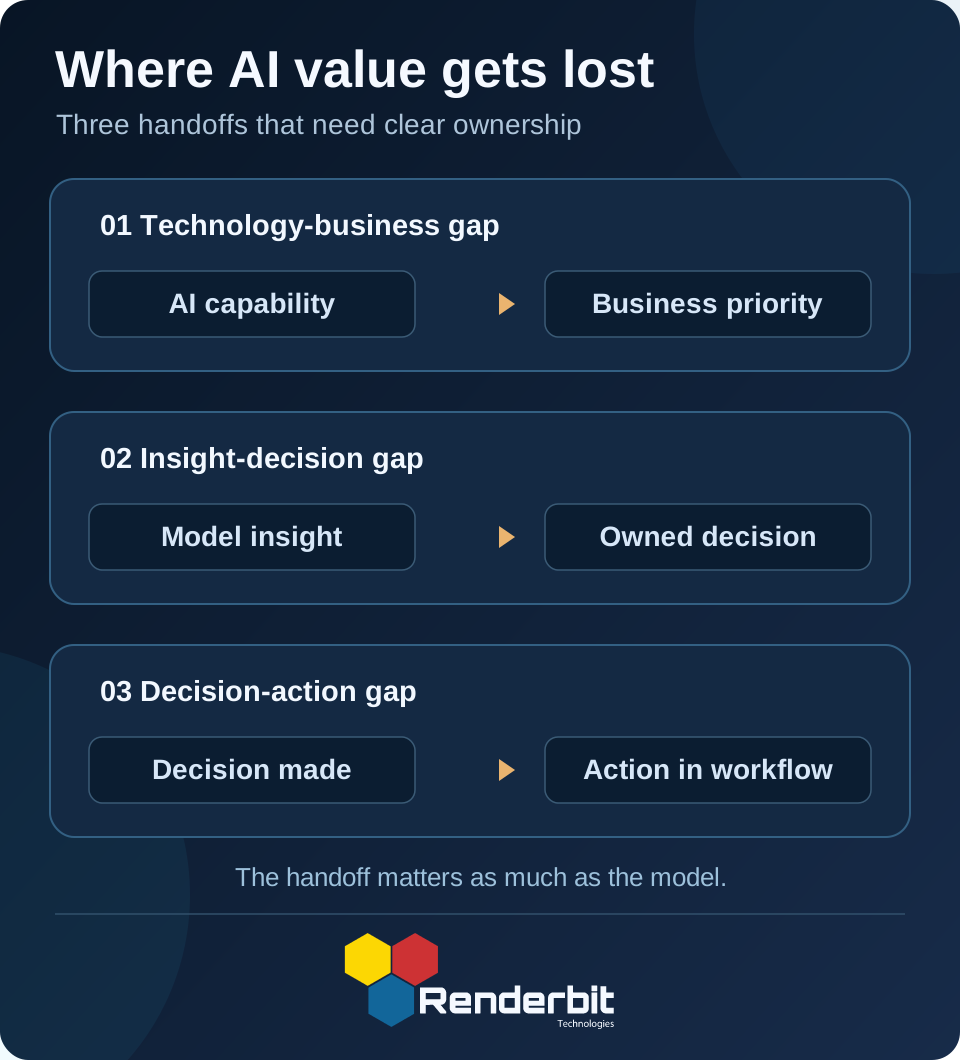
1. The gap between technology and business goals
An AI project may begin with an available tool rather than a problem worth solving. Teams ask where they can deploy generative AI, machine learning, or agents before agreeing on the outcome they want.
The result can be a polished demo with no clear owner or place in daily work.
Start with a business goal. To reduce late deliveries, for example, identify decisions about rerouting, customer alerts, or extra capacity. Then ask what intelligence could improve them.
2. The gap between insight and decision
An insight is not yet a decision. A model might predict churn, delays, or falling demand. Someone still must decide what to do, when, and at what cost.
Without an owner or a clear response, the prediction becomes another dashboard item.
Useful intelligence answers: What should happen next? Sometimes a simple, trusted rule is enough.
3. The gap between decision and action
Even a sound decision creates little value if it does not change what happens.
An alert may reach the wrong person, arrive too late, or require staff to copy data across systems. An automated action may lack the right permissions or exception handling.
Workflow design matters as much as model design: triggers, owners, approvals, integration, and feedback.
Follow the Full Path From Data to Outcome
A useful way to plan an AI initiative is to trace the entire path:
Business goal → decision → trusted data → intelligence → action → measured outcome → learning
Each part has a practical question attached to it:
| Step | Question to answer |
|---|---|
| Business goal | Which result are we trying to improve? |
| Decision | What choice has the greatest effect on that result? |
| Data | Is the right information reliable and available in time? |
| Intelligence | What prediction, recommendation, or generated output helps make the choice? |
| Action | Who or what will act, within which rules and workflow? |
| Outcome | How will we know whether the action worked? |
| Learning | What should change before the next decision? |
The sequence keeps investment focused. Teams can avoid building data systems they do not need, choosing models that are too complex, or leaving workflow design until after the demo.
A Customer Retention Example
Imagine a subscription business that develops a model to identify customers likely to cancel.
Model quality, latency, and data freshness matter, but the retention team needs more:
- A risk signal reaches the right account owner while there is still time to respond.
- The signal includes enough context to choose a suitable intervention.
- The CRM creates or updates a task, with clear ownership and a deadline.
- The team records what it did and whether the customer stayed.
- The business compares outcomes with a useful baseline or control group, where possible.
If the signal never reaches the team, it has little impact. If it prompts costly offers to customers who would have stayed anyway, high activity can hide poor returns.
The goal is not to maximize predictions or outreach. It is to improve retention after accounting for the cost of the intervention.
Six Capabilities That Help AI Scale
Lasting results need six capabilities working together.
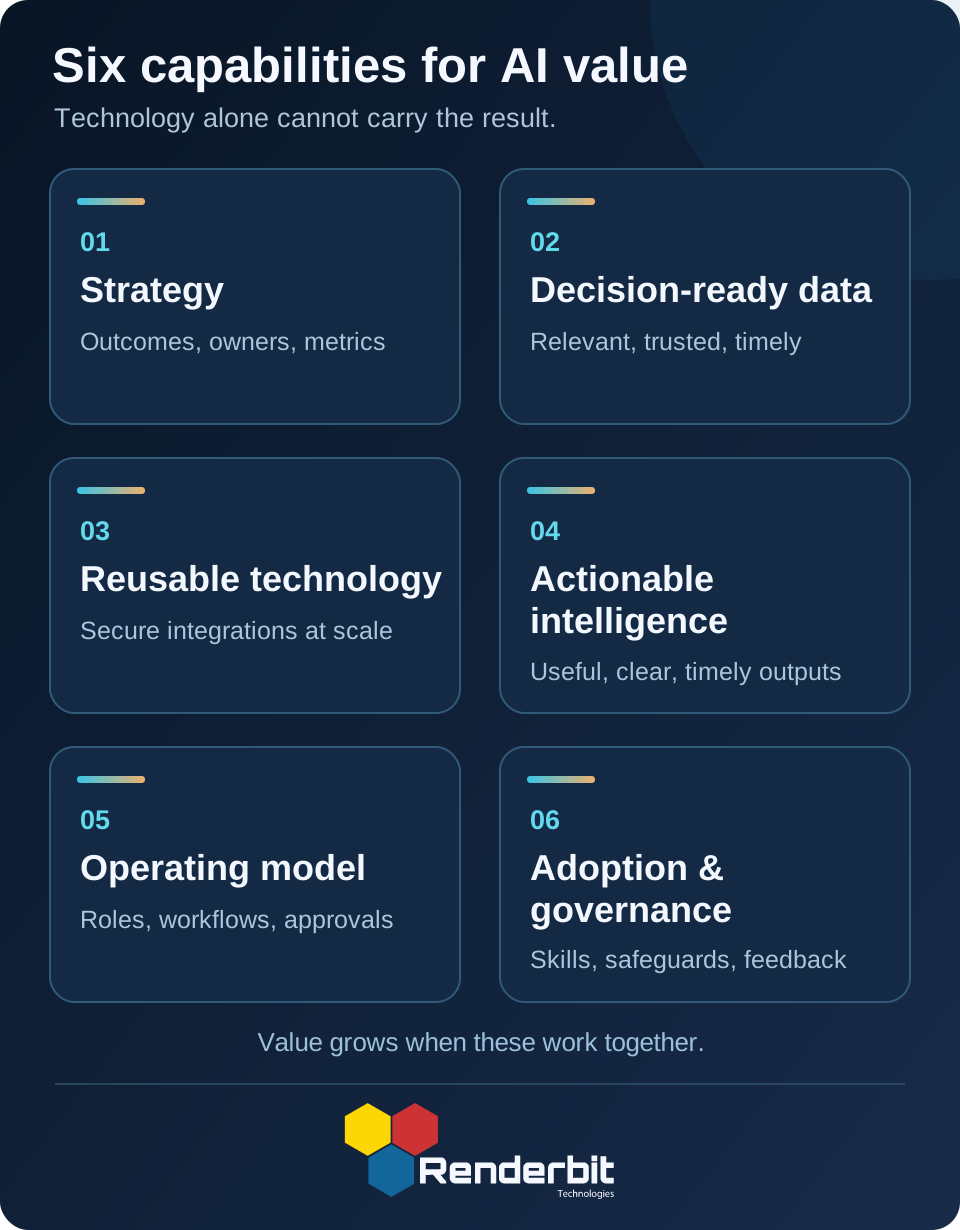
1. Strategy tied to outcomes
Prioritize growth, cost, risk, service, or productivity goals. Set an owner, baseline, and success measure before development.
2. Data ready for the decision
Use relevant, accurate, timely data that people and systems can access and understand.
3. Technology designed for reuse
Build reusable integrations, shared services, monitoring, and deployment processes. Avoid isolated pilots that each need their own data pipeline.
4. Intelligence that people can act on
Outputs must be timely, clear, and tied to a choice. Consider the cost of errors and whether users trust the result.
5. An operating model with clear ownership
Set decision rights and approval rules. Put recommendations in existing tools, not another dashboard.
6. Adoption and governance
Train teams, define safeguards, and record feedback. For AI agents that can take action, set access limits, audit logs, and human review for high-risk steps.
Models cannot make up for poor data; infrastructure cannot fix unclear ownership; pilots cannot deliver value without adoption.
How to Close the AI Value Gap
A focused process can produce better evidence than a long list of disconnected pilots.
1. Pick one high-impact decision. Choose something frequent or costly enough that an improvement would matter. Name the owner and the business measure you want to change.
2. Map what happens today. Identify where the data comes from, how the team decides, how the action happens, and where delays or errors enter the process.
3. Use the simplest useful intelligence. Test whether a rule, a report, a prediction, a generative model, or an agent is the right fit. Include reliability, cost, and risk in that choice.
4. Put the result inside the workflow. Send outputs to the right system at the right time. Define approvals, exception handling, and how staff can correct or override a recommendation.
5. Measure the full result and improve it. Track both use and outcomes: time to decide, share of recommendations acted on, quality of decisions, cost per action, and the final business metric. Compare with a baseline and feed the findings into the next iteration.
For high-risk processes, review failures and safeguards before increasing autonomy.
The Advantage Is in Execution
As AI tools become easier to access, the harder task is linking them to business decisions and processes.
Instead of counting shipped AI features, ask which decisions improve, which actions happen faster, and which outcomes prove the change matters.
At Renderbit, we believe AI should be part of a product and operating strategy, with engineering choices guided by business needs. The strongest AI initiative is not necessarily the one with the most advanced model. It is the one that people can trust, use, measure, and improve.
That is how AI investment becomes business value.
Related Blogs
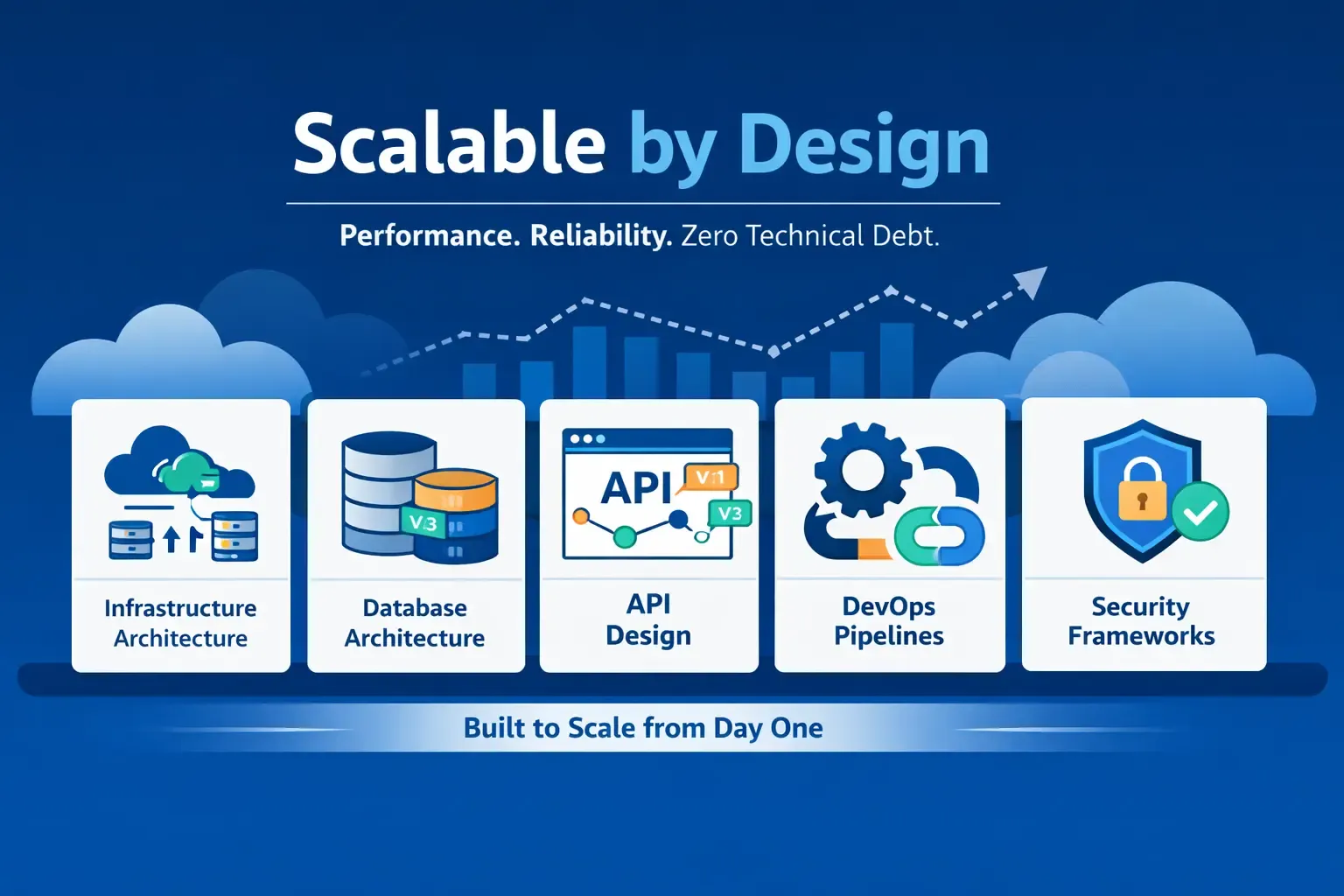
Scalable by Design: Building Cloud-Native Systems Right
Learn how scalable cloud-native architecture eliminates technical debt and ensures performance, reliability, and long-term growth for digital products.
Scalable by Design: Building Cloud-Native Systems Right
Learn how scalable cloud-native architecture eliminates technical debt and ensures performance, reliability, and long-term growth for digital products.
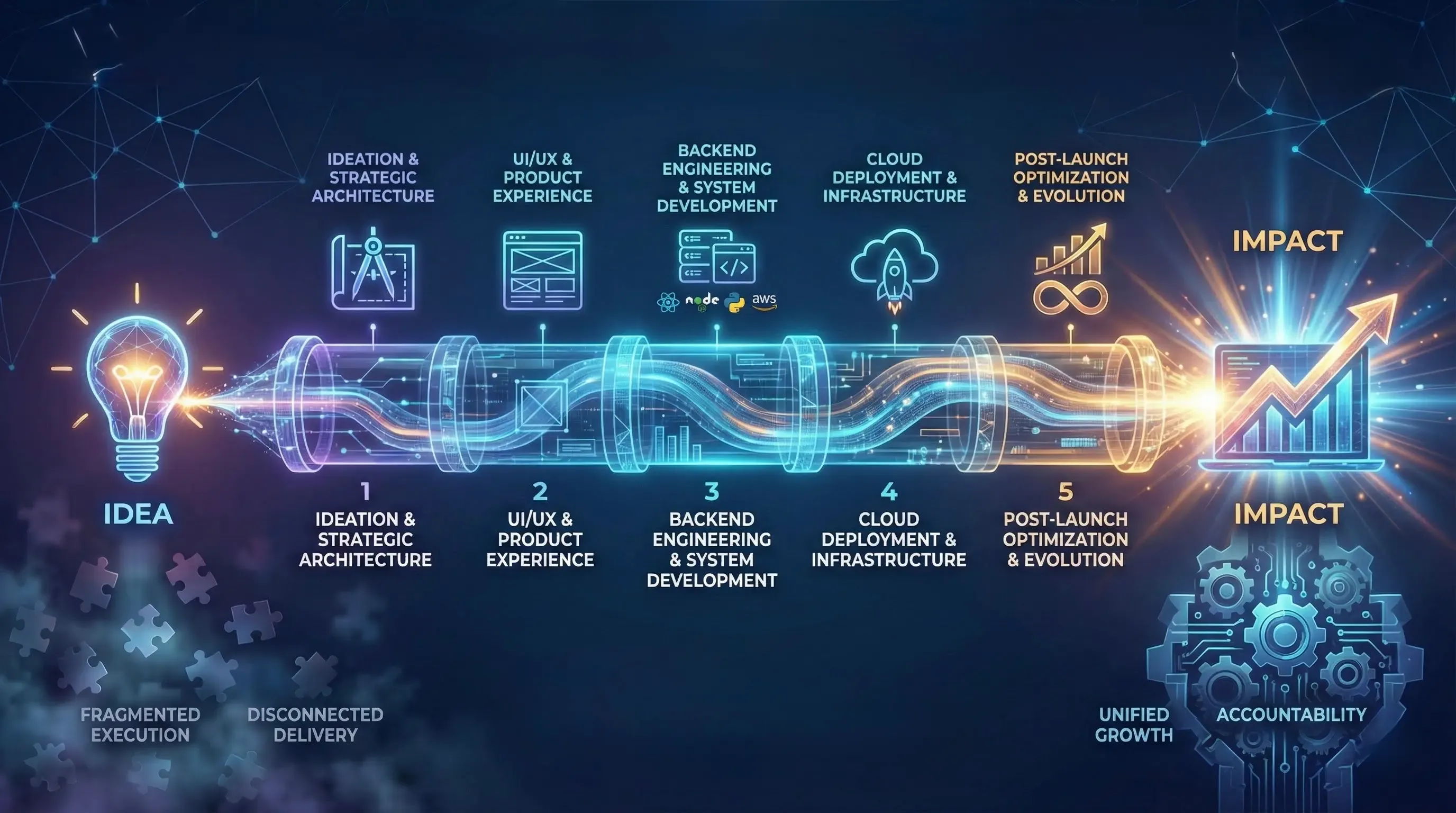
End-to-End Product Development | Full Lifecycle Execution
From ideation to deployment and optimization, Renderbit delivers end-to-end product development with scalable architecture and production-grade execution.
End-to-End Product Development | Full Lifecycle Execution
From ideation to deployment and optimization, Renderbit delivers end-to-end product development with scalable architecture and production-grade execution.
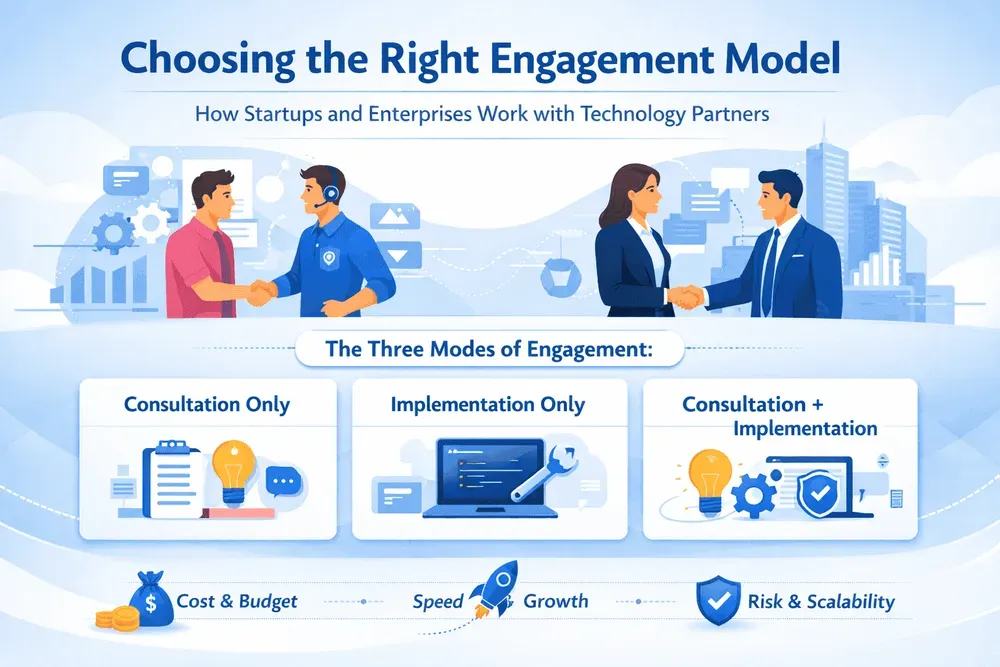
Choosing the Right Engagement Model: How Startups and Enterprises Work with Technology Partners
Explore the three key engagement models, consultation only, implementation only, and consultation + implementation, to choose the best technology partnership for your startup or enterprise.
Choosing the Right Engagement Model: How Startups and Enterprises Work with Technology Partners
Explore the three key engagement models, consultation only, implementation only, and consultation + implementation, to choose the best technology partnership for your startup or enterprise.
See Our Work in Action. Start Your Creative Journey with Us!

Renderbit Helper
Welcome!
How can I help you today?